
PDM or ERP?
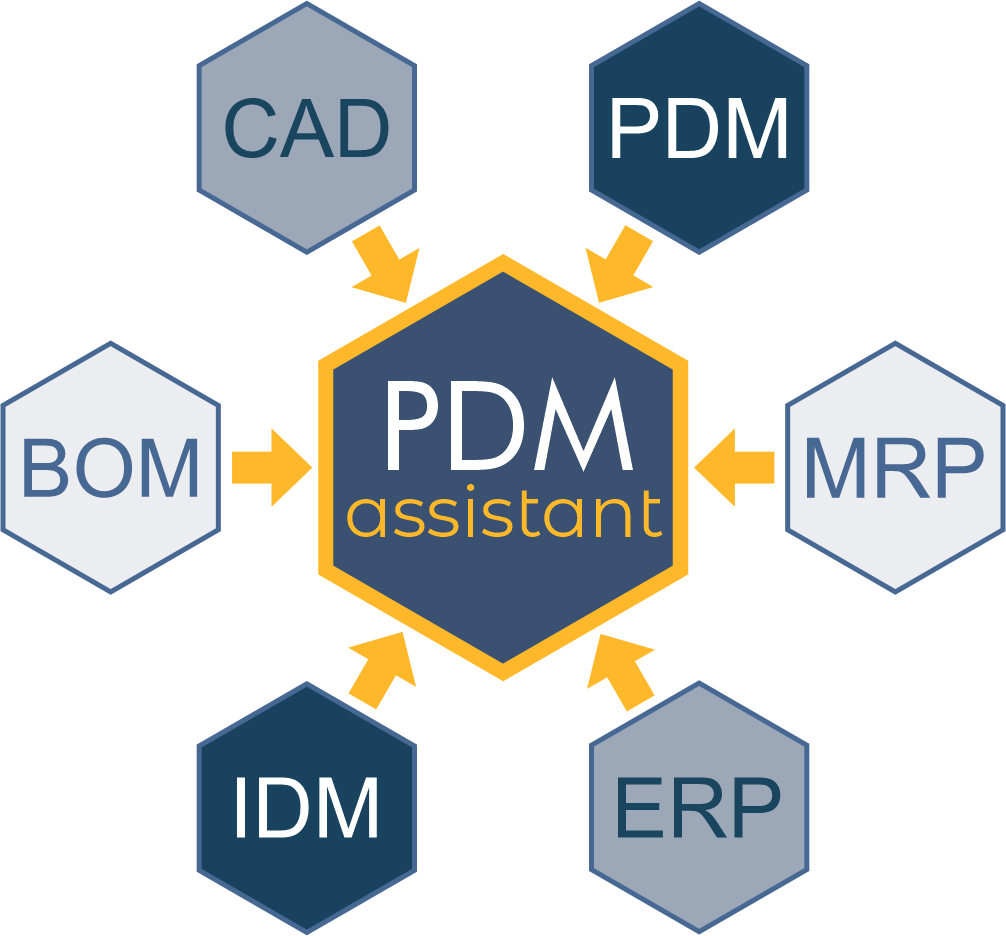
The main tasks of PDMassistant are to organize the information for design, production and delivery of products, facilitate access to this information and control its status at all the listed stages. What does this mean? First, let's understand the terms used:
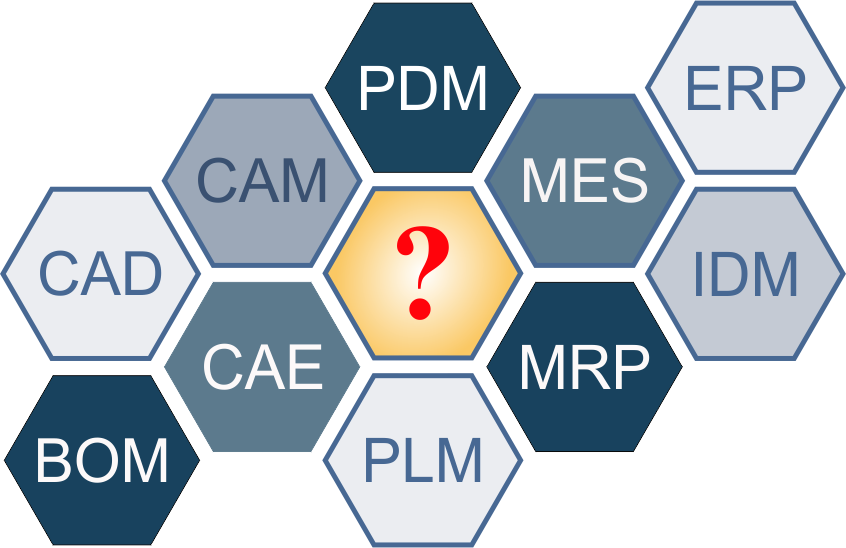
- BOM (Bill of Materials)
- a list of the raw materials, parts, assemblies and their quantities.
- CAD (Computer-Aided Design)
- software for design engineers for development of products on a computer.
- PDM (Product Data Management)
- software for managing technical data (including documents) of a product.
- MRP (Material Resource Planning)
- software for planning of material resources in manufacturing.
- ERP (Enterprise Resource Planning)
- software for planning of all enterprise resources, including human resources.
- IDM (Identity Management)
- access control and user credentials management software.
Design documents (mostly drawings and specifications) are at the beginning of the product information flow. Various CAD systems are an extremely effective and already established solution for designing products and issuing design documentation. Companies that have been designing their products using 3D CAD systems for many years have no doubts about the need to use them from a business point of view. They know very well that designing in 3D CAD brings many financial benefits, and such a solution is worth investing in.
The basis of information about a product is various specifications (BOM) - from a simple design specification of a unit to a final specification for the entire product. What types of specifications will be used by a company - depends on the complexity of the production process, but design and final specifications are always used. The first is created by the designer when issuing design documentation, and the second is calculated by summing up all the specifications included in the product. It is the final specification that is the basis for calculating and planning all subsequent processes in production.
Design engineers create a lot of files and documents, which raises the issue of organizing and managing this information. This is what PDM systems do. And this is why the vast majority of PDM solutions currently available on the market are tightly coupled (integrated) with a specific CAD system. Since the degree of integration is quite high, they have proven themselves to be quite effective means of managing versions of drawings and specifications, thereby reducing the time spent by the designer on finding the necessary data and eliminating errors. Product data, i.e. primarily 3D models and associated 2D drawings, are collected in a central database, which is accessible to members of the design team (CAD users).
However nowadays product development is rarely carried out using only one CAD system. For example, various systems can be used: systems for designing parts (3D CAD), systems for developing electronic components (ECAD), systems for creating plans and diagrams (2D CAD), systems for processing parts on CNC machines (CAM), systems for engineering calculations (CAE), etc. In addition, in real production, data from a PDM system alone is not enough, because employees of other departments (for example, supply or production) are not CAD users, but must have access to design information in a format convenient for them. Therefore, today it is necessary to connect PDM with the following levels - material resource planning systems (MRP) and, finally, enterprise resource planning systems as a whole (ERP). For maximum management efficiency, it is also necessary to include project management processes and task formation for all stages in the information flow.
Despite the undeniable advantages of moving to each subsequent level of information organization, the complexity of the process grows proportionally to the expansion of the range of tasks solved by the system. Assessing the scale of problems when moving to the next level is extremely difficult for company managers, since the necessary experience for this is most often absent. Choosing a too simple level may not justify hopes and not give the desired effect, and an attempt to implement a high-level solution in the absence of the necessary resources can drag on for years, lead to unjustified costs and disappointment in the chosen solution. But even after successful implementation, companies often do not use all the capabilities of high-level systems, which means that the effectiveness of the solution as a whole decreases. So is a simple but highly effective information flow management system possible at low costs?
Understanding all these problems, we have developed the simplest solution that covers the main issues of the company (from order to shipment) and does not contain anything unnecessary. See for yourself by trying our PDMassistant system for free!


 +48 574 580 438